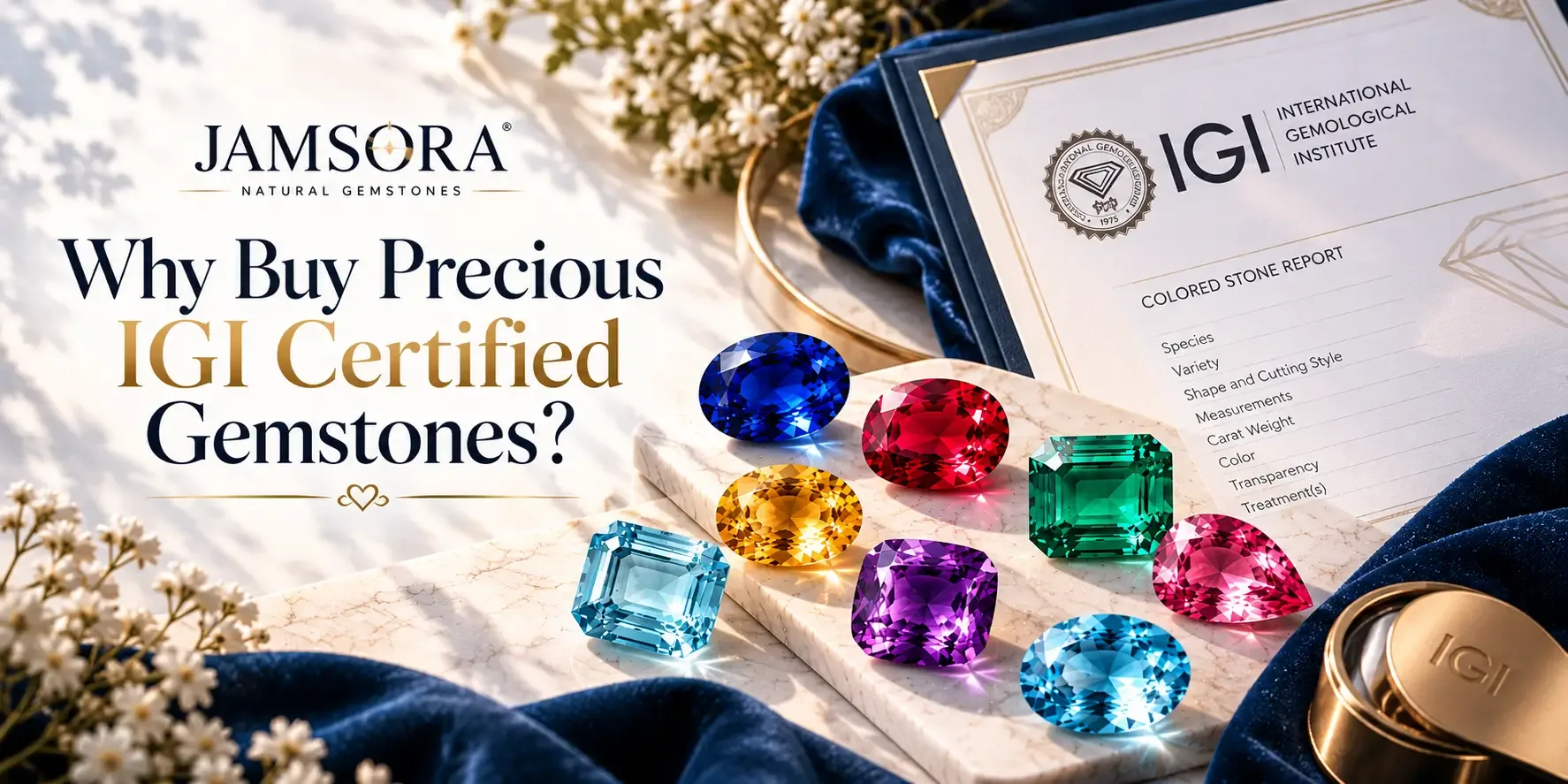
Why Buy Precious IGI-Certified Gemstones?
Buying a precious gemstone is different from buying an ordinary product. A natural ruby, sapphire, emerald, or another fine gemstone may look beautiful in photographs, but appearance alone cannot tell you everything about what you are buying.
October 6, 2026 · 13 min read
Is the gemstone natural? Has it been treated? Are the weight and measurements accurate? Does the stone match the information provided by the seller?
These questions become especially important when buying a valuable gemstone online.
This is where an independent gemological report can be useful. An IGI gemstone report provides professional identification and documented information about a gemstone, helping buyers understand their purchase with greater confidence.
In this guide, we'll explain what IGI certification means, what information a gemstone report can provide, and why documentation matters when buying precious natural gemstones such as sapphire, ruby and emerald.
What Does IGI Certified Mean?
IGI stands for the International Gemological Institute (IGI), an independent gemological organization that evaluates diamonds, colored stones, and jewelry.
When people use the term “IGI-certified gemstone,” they generally mean that the gemstone has been examined by IGI and is accompanied by an IGI report.
It is useful to understand one small distinction: the report does not make a gemstone natural, rare, or high quality. Instead, laboratory examination provides independent information about the stone that can help a buyer understand what is being offered.
For valuable gemstones, that distinction matters.
Why Is Certification Important When Buying a Natural Gemstone?
Natural gemstones can vary enormously in quality and value.
Two blue sapphires may look similar in a photograph but have very different characteristics. One may be natural and untreated, another may have undergone treatment, while another material could be laboratory-grown.
Most buyers cannot reliably determine these differences just by looking at a stone.
A professional gemological report provides an independent reference point between the gemstone, seller, and buyer.
That can be particularly helpful when shopping online, where you cannot physically examine the gemstone before placing an order.
1. It Helps Confirm the Gemstone's Identity
The first question when purchasing a valuable gemstone should be simple:
What exactly am I buying?
A professional laboratory examines the gemstone using gemological testing methods to determine its identity.
For example, a report may identify a stone as a natural sapphire, ruby, emerald, alexandrite, aquamarine, or another gemstone, depending on the specimen submitted.
This gives the buyer something more meaningful than relying solely on a product photograph or seller description.
2. Natural vs Laboratory-Grown Matters
Laboratory-grown gemstones can sometimes look remarkably similar to natural gemstones.
A laboratory-grown sapphire, for example, may have essentially the same basic chemical composition and crystal structure as natural sapphire. The important difference is its origin.
A natural gemstone formed through geological processes in the earth, while a laboratory-grown gemstone was created in a controlled manufacturing environment.
Neither should be misrepresented as the other.
If you're paying a premium for a natural gemstone, independent documentation can help establish that distinction.
3. Treatment Disclosure Is Important
Treatment is one of the most important subjects in the colored gemstone market.
Natural gemstones may undergo treatments intended to improve their appearance.
Depending on the gemstone, treatments can include methods such as:
- Heating
- Clarity enhancement
- Filling
- Diffusion
- Dyeing
- Other enhancement processes
Treatment does not automatically mean that a gemstone is undesirable.
For example, heat treatment is common and widely accepted for many sapphires and rubies when properly disclosed. Our guide to untreated vs heated gemstones explains the difference in more detail.
The issue is transparency.
A buyer should know whether a gemstone has been treated because treatment can influence its rarity, care requirements, desirability, and market value.
An independent laboratory report can provide important information about detectable treatments.
4. It Provides Accurate Gemstone Details
When buying loose gemstones online, small details matter.
A gemstone report can document important identifying information associated with the stone, depending on the type of report, such as:
- Gemstone variety
- Weight
- Measurements
- Shape
- Cutting style
- Color
- Treatment findings
This information gives the buyer a documented description that can be compared with the gemstone being offered.
It is particularly useful when comparing several stones before deciding which one to purchase.
5. Certification Adds Confidence When Buying Online
Buying a gemstone online requires trust.
You cannot hold the stone in your hand, examine it under different lighting conditions, or take it to a gemologist before purchasing.
High-resolution photographs and videos certainly help, but they still don't answer every gemological question.
Independent documentation adds another layer of information.
Instead of simply seeing “Natural Blue Sapphire,” the buyer can review laboratory information associated with the actual gemstone.
That doesn't replace the need to choose a trustworthy seller, but it can make the buying process more transparent.
6. Certification Is Especially Useful for Precious Gemstones
Documentation becomes increasingly important as the value of a gemstone increases.
This is particularly relevant when purchasing precious colored gemstones such as:
Natural Sapphire
Sapphires can vary considerably according to color, treatment, clarity, cut, size, and other characteristics.
For fine sapphires, knowing whether there is evidence of heat treatment can be particularly important. Read our blue sapphire buying guide or browse natural sapphires.
Natural Ruby
Ruby is another gemstone where treatment disclosure matters.
Heat treatment is common, while some rubies can undergo other enhancement methods. Buyers should understand what they are purchasing rather than assuming that every natural ruby has the same treatment history. See our natural ruby buying guide or browse natural rubies.
Natural Emerald
Emeralds commonly contain natural fissures and inclusions, and clarity enhancement is widespread in the market.
Understanding the gemstone and any disclosed enhancement is therefore important when comparing emeralds. Our natural emerald buying guide covers what to look for, or you can browse natural emeralds.
Natural Alexandrite
Alexandrite is prized for its unusual color-change phenomenon and can be extremely valuable in fine qualities.
Laboratory documentation can be particularly useful because laboratory-grown alexandrite and other color-changing materials also exist. Browse natural alexandrite.
7. A Report Makes Comparing Gemstones Easier
Imagine you are comparing two natural blue sapphires online.
Both weigh approximately two carats. Both appear blue. Both look attractive in photographs.
But that does not mean they are equivalent.
One may have better color. One may be heated while the other shows no evidence of heat. Their dimensions may differ. Their transparency and cutting quality may differ considerably.
A laboratory report won't tell you which stone you personally find more beautiful, but it can give you important factual information that makes the comparison more informed.
You can then evaluate the documented characteristics alongside:
Color + Cut + Transparency + Size + Price + Personal Preference
8. Certification Does Not Mean Every Stone Has the Same Quality
This is an important point that is sometimes misunderstood.
An IGI report should not be interpreted as saying “This is an excellent gemstone.”
Two natural gemstones can both have laboratory reports and still differ significantly in beauty, rarity, and value.
Certification provides information and identification.
The buyer still needs to evaluate the individual stone.
For colored gemstones, pay particular attention to:
- Color
- Saturation
- Tone
- Transparency
- Inclusions
- Cut quality
- Carat weight
- Treatment
- Overall appearance
Think of the report as part of the buying decision rather than the entire decision.
9. Does Certification Increase a Gemstone's Value?
Not automatically.
A laboratory report does not transform an average gemstone into a valuable one.
The gemstone's characteristics determine its desirability.
However, reliable documentation can make an important difference because significant claims about a gemstone can be independently supported rather than simply asserted by the seller.
For a rare or expensive natural gemstone, this can be particularly valuable. If you are buying with long-term value in mind, read are natural gemstones a good investment?
10. Why Certification Matters for Untreated Gemstones
Terms such as “unheated sapphire” or “untreated ruby” can carry significant meaning in the gemstone market.
Fine natural gemstones without certain treatments may be considerably rarer than comparable treated material.
Because these differences are not always something a consumer can determine visually, an independent laboratory examination becomes particularly useful.
If you are paying a premium because a gemstone is represented as having no evidence of heat or another significant treatment status, appropriate laboratory documentation should be considered.
11. Certification and Gemstone Origin
You may see gemstones described using geographical terms such as:
- Sri Lankan sapphire
- Burmese ruby
- Colombian emerald
- Mozambique ruby
- Kashmir sapphire
Geographic origin can influence the desirability of certain exceptional gemstones.
However, origin should not simply be assumed from appearance.
Determining geographic origin is specialized gemological work and may not always be possible. Whether origin information is included also depends on the laboratory service and the individual stone.
If geographic origin is an important reason for paying a premium, look for appropriate independent documentation rather than relying only on a marketing description.
12. Certification Helps With Future Documentation
A fine natural gemstone may remain in a family for many years.
It might eventually be:
- Set into a custom ring
- Made into a pendant
- Passed to another family member
- Added to a gemstone collection
- Professionally valued or insured
Keeping the gemstone together with its original laboratory documentation provides useful information about the stone for the future.
This is one reason buyers should keep their gemstone report safely stored even after the gemstone has been set into jewelry.
IGI Report vs Seller Certificate
These should not automatically be treated as the same thing.
A seller may provide its own certificate or product documentation. This can contain useful information, but it is issued by the seller.
An independent laboratory report is different because the gemstone has been examined by an organization separate from the retailer.
| Independent IGI report | Seller certificate | |
|---|---|---|
| Issued by | An independent gemological laboratory | The retailer selling the stone |
| Stone examined by | Laboratory gemologists | The seller |
| Can be verified online | Yes, through IGI's official verification service | Usually not |
| Best used for | Independent confirmation of identity and detectable treatments | Product details and the seller's own description |
For a significant purchase, that independence can provide additional confidence.
Ideally, the seller's product description and the independent laboratory report should complement each other.
Can You Trust a Gemstone Just Because It Has a Certificate?
You should still check the report carefully.
Before purchasing a certified gemstone:
Check the Report Number
Make sure the report number corresponds with the documentation supplied for the gemstone.
Verify the Report
Use the laboratory's official report-verification service where available.
Compare the Details
Check whether details such as weight, measurements, shape, and description correspond with the gemstone being offered.
Read Treatment Information
Don't simply look at the gemstone name. Read the complete report carefully.
Buy From a Reputable Seller
Certification should support a trustworthy buying process—not replace it.
How to Verify an IGI Report
If you receive an IGI report number, use the official IGI website rather than an unknown third-party verification page.
Verify an IGI report on the official IGI website
Enter the relevant report information and compare the available details with the documentation supplied with the gemstone.
This is a simple but worthwhile step, particularly for an online purchase.
What Certification Cannot Tell You
Certification is useful, but it has limits.
A report cannot decide:
- Which color you personally prefer
- Whether an oval or cushion shape suits your jewelry design
- Whether the gemstone looks beautiful to you
- Whether its price fits your budget
- Whether you will enjoy owning it
If you are still deciding on a shape, our gemstone shape guide and oval vs cushion vs emerald cut comparison can help.
Gemstones are both technical and emotional purchases.
The report helps with the technical side.
Your eyes and personal preference still matter.
How to Choose an IGI-Certified Natural Gemstone
When shopping for a natural gemstone, use a simple process.
- Choose the gemstone. Decide whether you're looking for sapphire, ruby, emerald, alexandrite, or another natural gemstone.
- Choose your preferred color. For colored gemstones, color is one of the most important visual characteristics.
- Check the cut. Look for attractive proportions, symmetry, and good light performance.
- Review the treatment. Understand whether the gemstone has undergone treatment and what that means.
- Review the laboratory report. Compare the report with the gemstone listing.
- Look at real images and videos. Whenever possible, view the actual stone rather than relying only on generic images.
- Check the seller's policies. Review shipping, returns, and other important purchase terms before placing your order.
Certified Doesn't Mean You Should Ignore Beauty
It is easy to become too focused on paperwork when buying a gemstone.
But natural gemstones are ultimately chosen because of their beauty.
If you're comparing two properly documented natural sapphires and one has a much more attractive color to your eye, that difference matters.
Certification should help you understand the gemstone.
It shouldn't replace your personal judgment.
The best buying decision combines:
Reliable documentation + beautiful gemstone + clear disclosure + trustworthy seller + personal preference
Why Documentation Matters at JAMSORA
For an online natural gemstone business, trust should be built through information rather than exaggerated promises.
Buyers should be able to understand what gemstone they are purchasing, review its important characteristics, and see appropriate documentation where provided.
At JAMSORA, certification should therefore be presented as part of a broader commitment to transparency.
A laboratory report is valuable because it gives the customer independent information about the gemstone—not because a certificate alone makes a stone beautiful or valuable.
That distinction helps buyers make better decisions. You can browse our IGI-certified gemstones, and if you have a question about a specific stone or its report, contact us.
Frequently Asked Questions
What is an IGI-certified gemstone?
The phrase generally refers to a gemstone that has been examined by the International Gemological Institute and is accompanied by an IGI report describing relevant findings.
Does IGI certify natural gemstones?
IGI provides identification and reporting services for colored gemstones, including information relevant to natural and laboratory-grown materials and detectable treatments, depending on the service performed.
Does an IGI report guarantee that a gemstone is valuable?
No. A laboratory report provides gemological information. The gemstone's quality, rarity, beauty, market demand, and other factors influence its value.
Why should I buy a certified gemstone online?
Independent documentation can help you verify important information about a gemstone rather than relying only on photographs and a seller's description.
Are certified gemstones always untreated?
No. A gemstone can be treated and still have a laboratory report. Treatment findings should be reviewed on the report.
Is a seller certificate the same as an IGI report?
No. A seller's certificate is issued by the seller, while an IGI report is issued after examination by an independent gemological laboratory.
Should I verify an IGI report before purchasing?
For a significant purchase, yes. Use IGI's official report-verification service and compare the information with the gemstone being offered.
Is certification necessary for every gemstone?
Not necessarily. For inexpensive stones, laboratory testing may not always be practical. As the gemstone's value and the importance of claims about treatment or origin increase, independent documentation becomes more useful.
Final Thoughts
When purchasing a precious natural gemstone, beauty is important—but so is knowing what you are buying.
An independent IGI report can help provide documented information about the gemstone's identity and other characteristics examined by the laboratory. This is especially useful when buying online, where many important differences cannot be determined from photographs alone.
However, certification should never be viewed as the only measure of a good gemstone.
A thoughtful purchase considers:
- Natural identity
- Color
- Cut
- Clarity and transparency
- Carat weight
- Treatment
- Documentation
And, most importantly, the beauty of the individual stone.
For buyers choosing a natural gemstone for an engagement ring, special gift, collection, or future piece of jewelry, good documentation makes the buying process clearer and more transparent. If you are shopping for a ring, read is sapphire good for engagement rings?
That is the real value of certification: helping you understand the gemstone behind the beauty.
When you are ready, browse IGI-certified loose gemstones and use the filters to compare stones side by side.
Related Topics
- IGI Certified Gemstones
- IGI Certification
- Certified Gemstones
- Natural Gemstones
- Precious Gemstones
- Gemstone Certification
- Natural Sapphire
- Natural Ruby
- Natural Emerald
- Loose Gemstones
- Gemstone Buying Guide
- Certified Natural Gemstones
- Gemstone Authenticity
- Gemstone Treatments
- Gemstone Education
Ready to find your own gemstone?
Shop Certified Gemstones